
Depression is hard enough when treatment works quickly. It becomes exhausting when you have tried one antidepressant, then another, waited weeks each time, dealt with side effects, and still feel stuck. For some people, depression does not respond well to standard medications. This is often called treatment-resistant depression.
Esketamine, commonly known by the brand name Spravato, was developed for specific cases where depression has not improved enough with conventional antidepressant treatment. It is not a casual mood booster, not a first-line option, and not something to take at home. It is a supervised medical treatment for selected patients.
What Treatment-Resistant Depression Means
Treatment-resistant depression usually means that a person has not improved after trying at least two different antidepressants at adequate doses and for an adequate duration. This does not mean the person is “too negative” or “not trying hard enough.” It means the depression may involve brain pathways that are not responding to standard serotonin or norepinephrine-based treatments.
This is where esketamine is different. It works through another system in the brain, which is why it may help some people who have not responded to traditional antidepressants.
How Standard Antidepressants Usually Work
Most common antidepressants, such as SSRIs and SNRIs, work mainly through serotonin and norepinephrine pathways. These medicines can be very helpful for many people, but they often take several weeks to show meaningful benefit.
For some patients, that waiting period feels unbearable. Others complete a proper trial and still have severe symptoms. They may continue to experience low mood, loss of interest, poor sleep, hopelessness, fatigue, poor concentration, and thoughts that life is not worth living.
When repeated medication trials fail, a psychiatrist may consider other evidence-based options, depending on the diagnosis, risk level, medical history, and treatment goals.
What Makes Esketamine Different
Esketamine works mainly through the glutamate system, not the serotonin system. More specifically, it acts as an NMDA receptor antagonist. This affects glutamate signaling, which plays a major role in learning, mood regulation, and brain plasticity.
In simpler terms, esketamine may help the brain become more flexible again. Depression is not just sadness. In many people, long-term depression is associated with rigid negative thought loops, reduced motivation, and impaired stress recovery. Esketamine appears to affect the brain systems involved in forming and strengthening neural connections.
That is why it is often discussed as a treatment that may support neuroplasticity.
The Role of Glutamate, AMPA, and BDNF
When esketamine blocks NMDA receptors, it can trigger downstream changes in glutamate signaling. One important pathway involves AMPA receptors, which are linked to synaptic strengthening. This process may increase activity in pathways associated with Brain-Derived Neurotrophic Factor, commonly called BDNF.
BDNF supports the growth, repair, and survival of nerve connections. In depression, especially long-term or severe depression, some brain networks may become less adaptive. Esketamine may help promote synaptic repair and communication between brain cells.
This does not mean esketamine “rewires your brain overnight” in a magical way. That kind of language is oversold. A more accurate way to say it is that esketamine may rapidly influence brain plasticity pathways that are relevant to mood improvement.
Why Relief Can Be Faster Than Traditional Antidepressants
One reason esketamine gets attention is speed. Traditional antidepressants may take several weeks to produce meaningful improvement. Esketamine can produce improvement in some patients within hours or days, although response varies and not everyone benefits.
That speed matters in treatment-resistant depression because patients are often already exhausted by long treatment timelines. Faster symptom reduction can help patients re-engage with therapy, sleep routines, family life, and daily functioning.
Still, rapid improvement is not guaranteed. Esketamine is a serious treatment that requires careful screening and follow-up.
Esketamine and Suicidal Thoughts
Esketamine has also been studied in adults with major depressive disorder and acute suicidal ideation or behavior. This is a sensitive area and needs careful wording.
Esketamine may reduce depressive symptoms quickly in some high-risk patients, but it should not be treated as a standalone suicide prevention solution. If someone is at risk of suicide, hospitalization, close monitoring, crisis planning, and urgent psychiatric care may still be necessary.
No medication replaces immediate safety support when a person is in danger. When repeated medication trials fail, a psychiatrist in Kolkata can review the diagnosis, previous treatment response, medical history, and other factors before considering advanced treatment options.
Why Esketamine Is Usually Part of a Broader Treatment Plan
Esketamine is not meant to replace all other care. For treatment-resistant depression, it may be used alone or with an oral antidepressant depending on the indication, clinical judgment, and local regulatory guidance. For some depression presentations involving acute suicidal ideation or behavior, it may be used along with an oral antidepressant under close supervision.
A strong treatment plan may also include psychotherapy, sleep stabilization, family support, lifestyle correction, and management of other conditions such as anxiety, substance use, trauma symptoms, thyroid problems, or chronic pain.
Depression is rarely fixed by one intervention alone.
What Treatment Looks Like in Practice
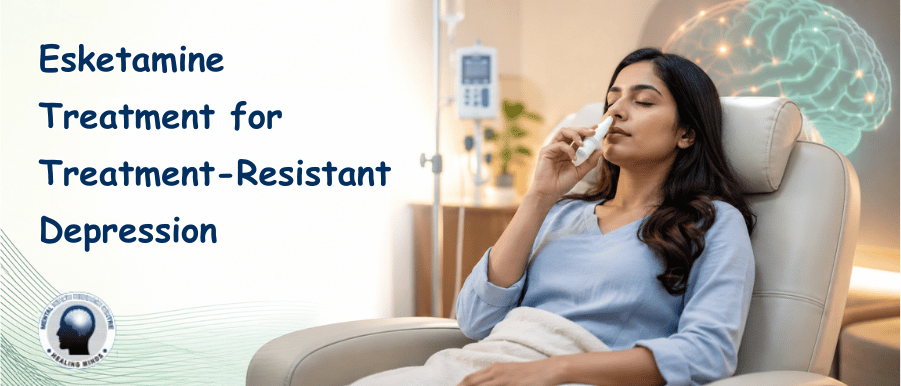
Esketamine is given as a nasal spray in a certified medical setting. The patient self-administers it under supervision, and the care team monitors them afterward. This is necessary because esketamine can cause short-term side effects such as dissociation, dizziness, sedation, nausea, increased blood pressure, and feeling disconnected from surroundings.
Patients are usually monitored for a period after dosing and should not drive or operate machinery until the next day after proper rest, as advised by the treating team.
This supervised model exists for safety. Esketamine is not the same as taking a tablet at home before bed.
Who May Be Considered for Esketamine
Esketamine may be considered for adults with treatment-resistant depression after proper psychiatric evaluation. A clinician will usually review the number of antidepressants tried, dose, duration, side effects, diagnosis accuracy, suicide risk, substance use history, blood pressure, medical history, and current medications.
It may not be suitable for people with certain vascular conditions, uncontrolled blood pressure, history of misuse risk, or other medical concerns. Pregnancy-related risks also need discussion in appropriate patients.
This is why self-referral based only on online reading is not enough. A proper psychiatric evaluation is non-negotiable.
Why Diagnosis Must Be Checked First
Before calling depression “treatment-resistant,” the diagnosis should be reviewed carefully. Sometimes depression does not improve because the real issue is bipolar disorder, trauma-related illness, substance use, ADHD, severe insomnia, personality-related patterns, grief, medical illness, or medication side effects.
If the diagnosis is wrong, stronger treatment is not the answer. Better assessment is.
A responsible psychiatrist will also check whether previous antidepressant trials were actually adequate. Some people stop early because of side effects. Others were on too low a dose. Others had poor adherence because depression itself made consistency difficult. These details matter.
The Hippocampus, Stress, and Depression
Long-term depression and chronic stress have been linked with changes in brain regions involved in memory and emotional regulation, including the hippocampus. This is one reason researchers are interested in treatments that affect neuroplasticity.
Esketamine’s potential role in supporting synaptic function is part of this broader scientific interest. However, it should be understood as a treatment with evidence, risks, and limits, not as a guaranteed brain repair therapy.
What Patients Should Expect Emotionally
Some patients feel hopeful when they hear about esketamine. Others feel nervous because it sounds unfamiliar. Both reactions are normal.
The right mindset is balanced. Esketamine can help some patients who have not responded to standard antidepressants, but it is not a miracle treatment. It requires commitment, monitoring, and a broader recovery plan. It may reduce symptoms, but patients still need support to rebuild routine, motivation, relationships, and coping skills.
When to Seek Urgent Help
If depression includes thoughts of self-harm, suicidal thoughts, inability to stay safe, severe agitation, psychosis, or inability to function, seek urgent psychiatric care immediately. Do not wait for a routine appointment. If depression has not improved despite previous treatment, you can visit our psychiatric clinic in Kolkata for an in-person assessment and discussion of appropriate treatment options.
Medical Disclaimer
This blog is for general education and does not diagnose or replace medical advice. Esketamine is a prescription treatment that must be given under medical supervision in appropriate patients. If you have depression that has not improved with treatment, consult a qualified psychiatrist for evaluation. If there are suicidal thoughts or immediate safety concerns, seek urgent medical help right away.

Dr. Sagnik Mukherjee, a distinguished Consultant Neuro-Psychiatrist, brings a wealth of experience and expertise to the field of mental health. With an academic background that includes an MBBS from Calcutta National Medical College, Kolkata, and an MD from SVS Medical College, Hyderabad, he has garnered recognition as one of Kolkata’s leading mental health professionals. Dr. Mukherjee’s illustrious career has seen him contribute his skills and knowledge to esteemed institutions such as Chittaranjan Hospital, SVS Medical College & Hospital Hyderabad, KPC Medical College, and Iris Hospital. Currently, he serves as a consultant at the Mental Health Research Centre in Kolkata, located within the Marwari Relief Society Hospital, Bara Bazar. His areas of specialization encompass Child and adolescent psychiatry, de-addiction, schizophrenia, depression, and various types of anxiety disorders. Dr. Sagnik Mukherjee’s commitment to the field is underscored by his active participation in numerous international and national seminars on Psychiatry and mental health. His dedication and expertise make him a highly respected figure in the realm of mental health care in Kolkata.
